

|
Artist of the summer 2010 |
|
|
|
| | Konstnärer för sommaren 2011 publicerast i januari. Konstnärer i sommaren 2010 var: | | | | |
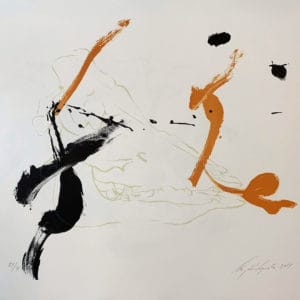
| Professor Lauri Ahlgrén (b. 1929), graphic artist and painter, is one of Finland’s leading figures of the Informalist movement which influenced strongly during the 1960s. Ahlgrén’s abstracts have bold colours and clean, organic shapes. It is almost as if his artworks create portholes to the space which continues to infinity extending beyond the margins of the picture. Ahlgrén was awarded the Pro Finlandia medal in 1969 and the Knight 1st Class of the Order of the White Rose of Finland in 1989. | | | | |
| Sculptor François Blosseville (b. 1969) has studied at the School of Fine Arts in Paris and, as a visiting student, at the Finnish Academy of Fine Arts. He works wood, marble and bronze, and loves moulding the matter and bringing out its basic characters. He digs the energy out of the pith of the wood in order to sculpture a storm or grinds the stone into being as smooth and transparent as the moonlight. Blosseville’s inspiration comes from nature, from clouds, women and life, or simply from the love of creation, doing and thinking. | | | | |
| Spanish artist Jesús Ángel Bordetas (b. 1978) transfigures every day objects and images in order to build his own world. In his compositions both items of popular culture as well as simple images of everyday life are merged together. In his paintings Bordetas experiments and explores the possibilities and limits of painting materials creating a new metavisual language. Jesús Ángel Bordetas worked as Art Centre Salmela’s winter scholar in Mäntyharju parish during 2009–2010. | | | | |
| Samuli Heimonen (b. 1975) graduated as the Master of Arts from the University of Art and Design Helsinki in 2002 and now lives and works in Kangasniemi. Heimonen held his first private exhibition in 2000 but has participated in joint exhibitions already since 1998. Heimonen’s paintings often depict something larger than human – an object, animal or a construction. Often human is, however, part of that construction, sort of living inside and on the surfaces of it. Heimonen was Salmela’s Young Artist of the Summer 2001 and was nominated as the Young Artist of the Year 2008. | | | | |
| Sculpter Johanna Häiväoja’s (b. 1960) art’s perspective is eternity. Even her small sculptures are monumental. Her language of form entails angularity and foldedness, and the imprint may remind of randomness. During her career, the artist has used i.a. steel and copper as materials for her artworks. | |
| |
| Kristian Krokfors (b. 1952), one of the linchpins of Finnish modern art, paints his own environment and his experiences of it. The focal point of Krokfors’ art is the language of form. Shapes are clean and organised without being boring or stagnant. Instead of aiming at realism, Krokfors concentrates on the colour, rhythm and on simplification. He depicts the views slightly from afar, from the bird's eye view. Repetition, which he uses as a stylistic means, creates a feeling of timelessness. The city lights glow and shine against the dark scenery creating a magical atmosphere. | | | | |
| Pirkko Nukari (b. 1943) is known as a portrayer of nature and animals, and a direct nature experience is often the basis for her sculptures. Nukari portrays nature being always in motion and close by. Made of heavy material with sensitivity and lightness, the little mammals and birds cast in bronze pulsate life. | | | | |
| Professor Kimmo Pyykkö (b. 1940) started his career in 1966 bringing out artworks welded out of scrap iron. The sculptures depicted a human figure connecting with other objects in the spirit of surrealism. Later came out e.g. the great aluminium, wood and bronze works. Just in couple of years Pyykkö became one of the most prominent young artists of the country, and in 1968 The Finnish Critics' Association awarded the 'Kritiikin kannukset' art award to Pyykkö for the artistic breakthrough of the year. Later on Pyykkö redeemed himself among the social opinion leaders as well. During his career he has done numerous public sculptures, latest of which was the street sculpture connected to an EU project in Paris. He has taken part in many international exhibitions i.a. several biennials and has hold close to 40 private exhibitions in Finland as well as abroad. Pyykkö was awarded the Pro Finlandia medal in 2008. | | | | |
| Annuli Viherjuuri’s (b. 1984) artworks deal with relationships, and they enchanted the visitors of Salmela last summer. Now she paints individual’s experiences by using human figure and abstraction. She ponders over how human is in a constant alteration when situations and feelings keep changing. It makes one ask “What is then lasting?” Viherjuuri’s artworks entail different levels and contrasts: movement’s dynamics and unassumingness, passing emotions and constancy as well as fragility and strength, overt and covert. Originally from Asikkala, now living in Helsinki, Viherjuuri has studied in Kankaanpää Art School. She is also Salmela’s Young Artist of the Summer 2010. | | | | The exhibition class of Salmela’s Visual Arts Competition for Young Artists: | | | |
| Sini Anttila-Rodriguez (b. 1973) | | | | |
| Petri Eskelinen (b. 1975) | | | | |
| Markku Haanpää (b. 1978) | | | | |
| Jussi Halonen (b. 1990) | | | | |
| Nana Hermunen (b. 1977) | | | | |
| Jonna Johansson (b. 1975) | | | | |
| Terhi Kaakinen (b.1979) | | | | |
| Klaus Kopu (b. 1978) | | | | |
| Teemu Korpela (b. 1980) | | | | |
| Maria Laine (b. 1983) | | | | |
| Salla Laurinolli (b. 1976) | | | | |
| Juhana Moisander (b. 1977) | | | | |
| Kasper Muttonen (b. 1979) | | | | |
| Asta Pajunen (b. 1982) | | | | |
| Pasi Rauhala (b. 1978) | | | | |
| Vappu Rossi (b. 1976 ) | | | | |
| Jari Rönkkö (b. 1983) | | | | |
| Kristiina Sario (b. 1979) | | | |
|